
Many competitive athletes struggle with subtle performance plateaus without realizing the root cause is visual. A player might continually mistime a half-volley or struggle to catch a pass over their shoulder, chalking it up to poor mechanics. In reality, they may be experiencing hidden functional bottlenecks that no amount of physical training can correct.
Hidden Visual Bottlenecks That Limit Performance
These conditions rarely show up on a standard prescription check, yet they directly undermine timing, spatial awareness, and reaction speed at the highest competitive levels.
The eyes struggle to team together accurately as an object quickly approaches the face, leading to misjudged catch timings and depth-perception errors on inbound balls.
Under high competitive stress, the brain may temporarily ignore data from one eye entirely, skewing depth perception and spatial tracking at the exact moment it is needed most.
The eye muscles "shudder" slightly rather than tracking smoothly, causing a fast-moving object to momentarily appear blurry or jumpy during a critical pursuit window.
How Specialized Optometrists Upgrade Visual Performance
A sports vision evaluation goes significantly deeper than a standard optical prescription check. Specialized clinics utilize automated instrumentation to benchmark sensory metrics before building a custom program.
Optometrists employ specialized sensory platforms — such as the Senaptec Sensory Station or RightEye tracking systems — to map an athlete's visual strengths and deficiencies against a global database of professional athletes. These tests measure exact reaction times down to the millisecond and map micro-movements of the eyes to identify suppression, tracking instabilities, and fixation errors that are completely invisible to standard clinical testing.
Once gaps are identified, the athlete undergoes structured visual training — essentially physical therapy for the brain and eye muscles, leveraging neuroplasticity: the brain's ability to forge new neural pathways through targeted repetition.
Athletes wear specialized liquid-crystal eyewear that strobes between clear and opaque states. By briefly removing visual data, the brain is forced to process limited information more efficiently, improving anticipation and timing.
Using large-scale digital light boards, athletes track and strike flashing targets to expand their peripheral capture zone and quicken hand-eye coordination response times.
Optometrists introduce loose prisms to shift visual space intentionally. Training under these conditions forces the vestibular and visual systems to recalibrate, enhancing core stabilization and spatial awareness.
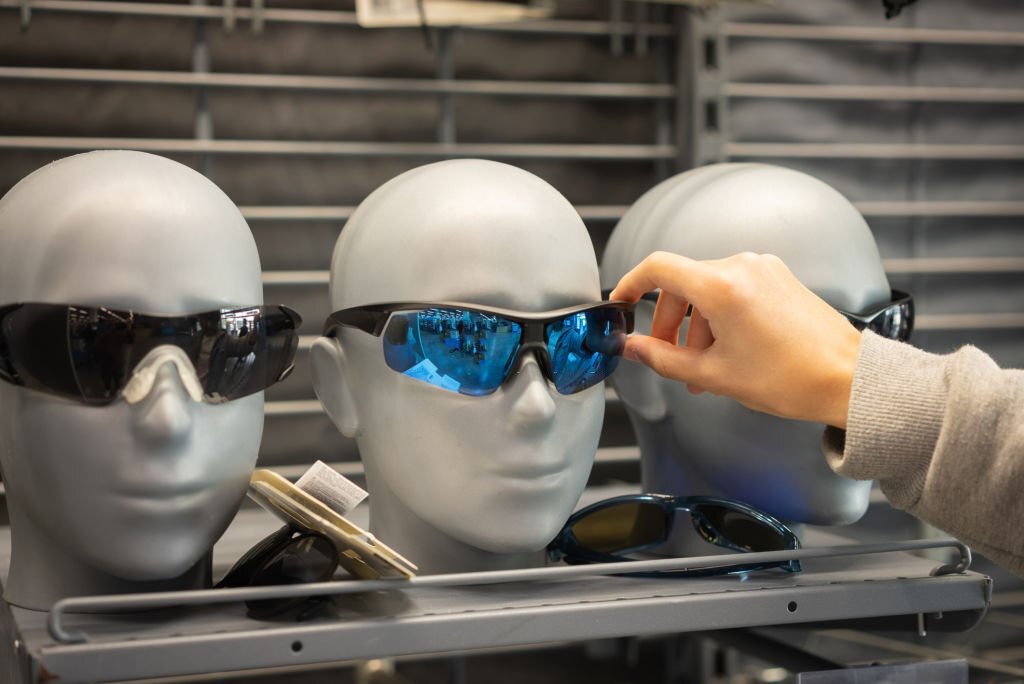
For athletes requiring refractive correction, standard daily eyewear can be dangerous or inefficient under competitive conditions. Optometrists fit specialized sports-performance contact lenses (which resist drying during high-airflow sports) or impact-resistant polycarbonate protective wrap goggles tinted with contrast-enhancing filters — for example, amber tints that make a yellow ball pop visually against a green grass background, improving object detection speed by several milliseconds.
Building a Complete Performance Ecosystem
Sports vision care is most effective when integrated into an athlete's overarching training regimen. Specialized optometrists regularly collaborate with the wider performance team to deliver compound results.
Visual drills are woven into existing conditioning blocks — for example, performing balance-board stability work while simultaneously tracking moving visual targets, compounding both motor and visual benefits.
Antioxidant carotenoids — specifically lutein and zeaxanthin — support macular health and contrast sensitivity. Optometrists advise on dietary targets to maintain peak retinal function during competition seasons.
Strict screen-time boundaries are established to alleviate visual fatigue accumulated from pre-game analysis and post-game video review, preventing performance decay from chronic digital eye strain.
High-quality sleep protocols allow the neurological pathways developed during vision therapy to consolidate daytime training gains. Optometrists coordinate sleep hygiene recommendations with physiotherapy and coaching staff.
The compound benefit of integrating visual training with physical conditioning, nutrition, and sleep recovery consistently outperforms isolated vision therapy alone — making the interdisciplinary approach the current clinical gold standard for elite sports vision performance.