
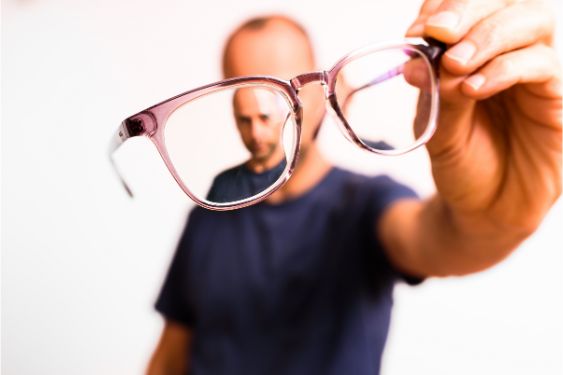
Stepping into your first pair of progressive lenses is a major milestone for your vision, but it does require your brain and eyes to learn a completely new way of processing the world. Because a progressive lens contains a gradient of changing optical powers rather than a single fixed prescription, looking through the wrong part of the lens can cause temporary swim effect, blur, or spatial disorientation.
Think of this transition period like learning to drive a new car - it takes a bit of deliberate practice before it becomes automatic muscle memory.
Implementing the following targeted visual exercises and lifestyle adjustments will help accelerate this neural adaptation, rapidly shrinking peripheral distortion and helping you find your visual sweet spots.
Exercise 1: Daily Visual Training
These simple, structural exercises are designed to retrain your oculomotor habits - the way your eyes and brain coordinate to lock onto targets through specific areas of your new lenses.
Traditional single-vision lenses allow you to glance sideways using just your eyes. If you do this with progressive lenses, your gaze will pass through the distorted peripheral edges, causing the world to appear to sway or tilt.
- How to do it: Imagine a soft laser beam extending straight out from the tip of your nose. Whenever you want to look at something to your left or right, consciously point your nose directly at the object before letting your eyes focus.
- The Goal: Moving your head instead of just your eyes keeps your line of sight perfectly centered within the clear vertical corridor of the lens. Practice this for 5 minutes every morning by tracking objects around your room.
This exercise trains your eyes to navigate the changing vertical prescription powers smoothly, helping you transition from intermediate distances to long-range vision without feeling disoriented.
- How to do it: Sit comfortably in a chair facing a window. Choose a close-up object in your lap (like a smartphone), a mid-range object (like a computer screen about a meter away), and a distant object outside the window.
- The Drill: Look at the phone for 5 seconds, slowly lift your chin to find the mid-range target through the middle of the lens for 5 seconds, then look straight ahead at the distant target for 5 seconds. Repeat this loop 10 times.
- The Goal: This teaches your brain to automatically adjust your chin height to find the correct optical power for varying distances.
Exercise 2: Reading and Close-Up Navigation
The reading zone sits at the very bottom of a progressive lens. Managing your head posture during close-up tasks is essential to avoid neck strain and blurred text.
| Reading Action | Correct Mechanical Adjustment |
|---|---|
| Reading a Book | Keep your head still, lower your gaze to the bottom zone, and slightly drop your chin. |
| Desktop Screens | Adjust your monitor height down slightly so you look through the intermediate zone. |
| Smartphone Use | Hold the device slightly lower and further out, letting your eyes drop naturally. |
When first trying to read, many wearers naturally drop their entire head downward. This movement causes your eyes to keep looking through the top distance zone of the lens, leaving the text blurry.
- The Correction: Keep your head relatively level. Instead of tilting your neck down, simply lower your eyes toward the bottom rim of the frame. If the text still feels slightly blurry, lift your chin up just a few millimeters until the letters snap into sharp focus.
- Managing Wide Pages: When reading wide documents or a physical newspaper, turn your head slightly from side to side as you read across the page, rather than just moving your eyes across the text.
Exercise 3: Spatial Awareness and Safe Navigation
Because the lower portions of your lenses are dedicated to close-up magnification, looking down while walking can make the ground appear closer or slightly curved.
Stepping off a curb or walking down stairs can feel disorienting at first because looking down naturally directs your gaze through your reading prescription, blurring your feet.
- The Golden Rule: When walking downstairs or stepping off a curb, always drop your chin down toward your chest. This physical tilt forces you to look at the ground through the top distance portion of your lens, ensuring the stairs remain flat, stable, and sharply defined.
Exercise 4: Environmental and Wearing Rules for Fast Success
The fastest path to progressive lens adaptation relies heavily on consistency. Partial or broken wearing habits will only prolong your discomfort.
Commit to wearing your new progressive lenses full-time from the moment you wake up until the end of the day. Put your old glasses away in a drawer. Constantly switching back to your old single-vision or bifocal spectacles interrupts your brain's neural adaptation process, resetting your transition timeline back to day one.
Spend the first day or two wearing your new lenses in a controlled, low-stress environment like your home or office. Avoid navigating high-density foot traffic, driving long distances in heavy rain, or playing fast-moving sports until you can find your visual zones automatically.
Clinical Support at EyeCare Studio
If you experience persistent eye strain, lingering headaches, or a swim effect that does not improve after a full week of consistent wear, your lenses may simply need a minor physical adjustment. Small tweaks to how the frame sits on your face - such as adjusting the nose pads or changing the pantoscopic tilt (the angle at which the lens sits relative to your cheeks) - can dramatically alter your visual clarity and widen your reading corridors.
Our registered optometrists at EyeCare Studio are always available to fine-tune your fit and ensure a seamless, comfortable transition. Visit any of our practices across Singapore for expert support:
- Jurong Point 2 (#01-13) - Tel: 6316 0676
- Serangoon NEX (#04-58) - Tel: 6636 8223
- The Seletar Mall (#01-25) - Tel: 6702 3412


